

Daily life doesn’t have to feel this hard.
At VITA Pediatrics, our Occupational Therapy services help kids build regulation, strength, and independence so they can shine at school, home, and everywhere in between.

The Power of Occupational Therapy
If you’re here, you’ve probably wondered why everyday things like homework, mornings, playdates, or daily routines feel harder than they should.
Maybe handwriting takes forever. Maybe meltdowns come out of nowhere. Maybe your child avoids things other kids seem to breeze through. You’ve tried visual schedules, patience, encouragement… and still, something feels off.
That’s where Occupational Therapy comes in.
OT isn’t about fixing a child or drilling skills. It’s about helping kids do the real work of childhood like getting dressed, joining peers, managing emotions, focusing at school, and moving through their day with more confidence and ease.
At VITA Pediatrics, OT looks at the whole child: body, brain, and emotional wellbeing because everything is connected. Writing challenges may stem from posture and core strength. Difficulty with routines can reflect sensory overload.
When OT is done well, progress isn’t just seen in sessions, it’s felt in calmer mornings, smoother transitions, and everyday life that flows more easily.
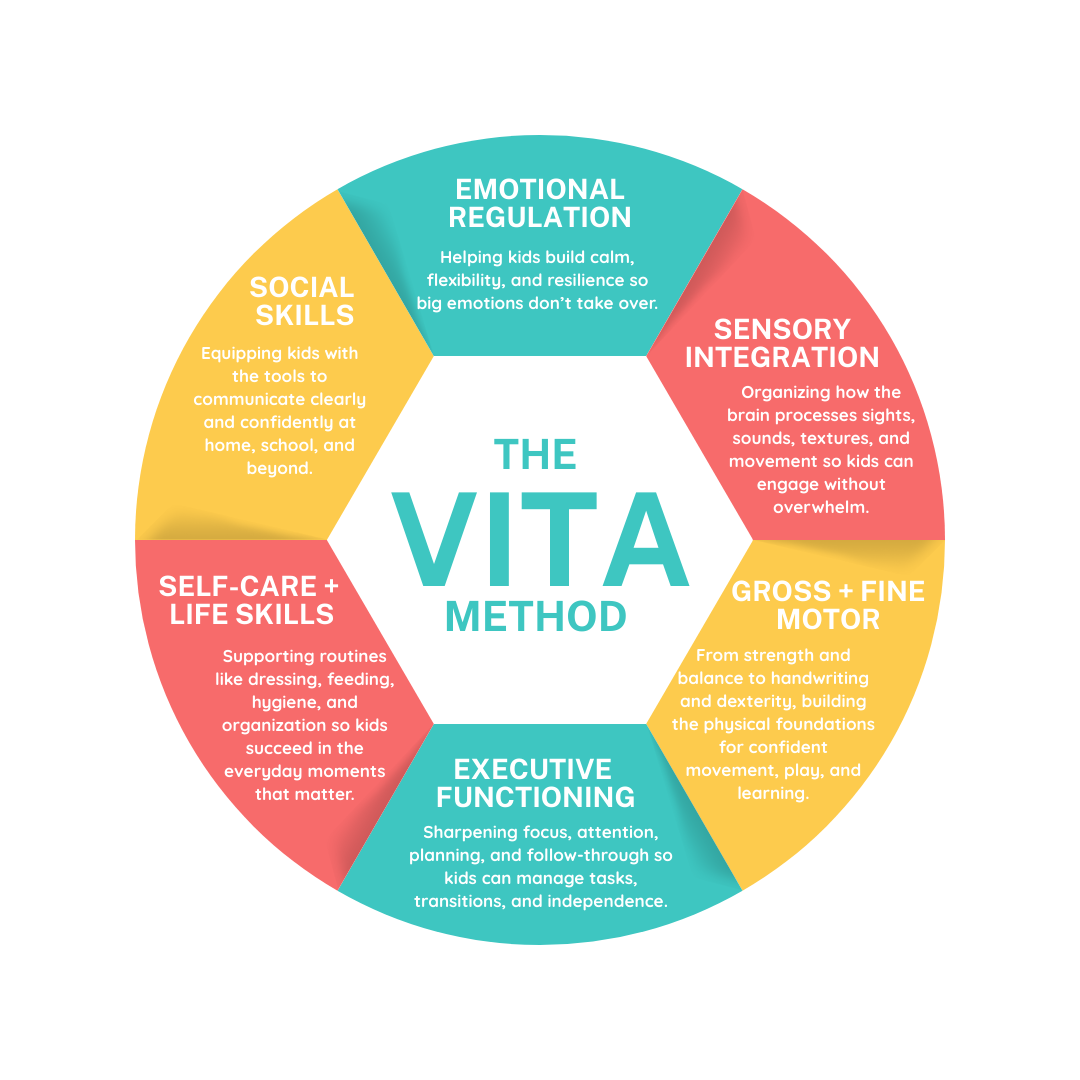
The Core Areas of Growth at VITA:
We’ve built our therapy at VITA around six core areas of development, because treating the whole child is where real change happens.
How OT Works at VITA:
We don’t believe in cookie-cutter therapy. Every child moves through our clear, three-step method:
1. Assess
A strengths-based evaluation that looks at the whole child, not just the symptoms. We get to the root.
2. Activate
A customized plan that’s practical, targeted, and tailored to your child and family.
3. Advance
Ongoing therapy with measurable progress that carries into home, school, and daily life.

Conditions We Treat:
At VITA Pediatrics, Occupational Therapy addresses both everyday challenges and complex medical or developmental conditions. Our team evaluates the whole child, emotional, sensory, motor, cognitive, and social systems.
Regulation & Emotional Needs
Frequent meltdowns, difficulty calming
Anxiety, rigidity with routines, difficulty adapting to change
Attention-Deficit/Hyperactivity Disorder (ADHD)
Emotional dysregulation related to trauma or stress
Sensory Processing & Integration
Sensory Processing Disorder (SPD)
Over- or under-responsiveness to sounds, textures, lights, or movement
Constant seeking of crashing, spinning, or deep pressure
Difficulty with busy, multi-sensory environments (classrooms, playgrounds)
Motor Delays & Coordination
Fine motor: handwriting, scissor use, utensil use, dressing
Gross motor (in partnership with PT): balance, coordination, posture, endurance
Dyspraxia / Developmental Coordination Disorder (DCD)
Low muscle tone (hypotonia) or poor core stability
Executive Functioning & Attention
Difficulty with attention, task initiation, or follow-through
Challenges with planning, sequencing, and organization
Working memory deficits
Executive dysfunction associated with ADHD, Autism Spectrum Disorder, and learning disabilities
Self-Care & Daily Living Skills
Dressing (buttons, zippers, shoes)
Hygiene (toileting, tooth brushing, bathing)
Feeding difficulties: picky eating, oral-motor delays, texture avoidance
Limited independence in daily routines at home or school
Social Participation & Peer Interaction
Difficulty joining group play or structured activities
Rigidity, inflexibility, or limited problem-solving with peers
Trouble reading body language, facial expressions, or social cues
Social challenges related to Autism Spectrum Disorder
Neurological & Complex Medical Conditions
Autism Spectrum Disorder (ASD)
Cerebral Palsy (CP)
Traumatic Brain Injury (TBI) or concussion recovery
Developmental Delay / Global Developmental Delay
Genetic and rare syndromes: Down Syndrome, Rett Syndrome,
Fragile X, Prader-Willi, Angelman, Williams, etc.)Neuromuscular disorders (Muscular Dystrophy, Spina Bifida,
Charcot-Marie-Tooth, etc.)Epilepsy and seizure disorders
Post-chemotherapy or oncology-related fatigue/coordination
Stroke, hypoxic brain injury, or other acquired neurological conditions

Don’t See What You’re Looking For?
Not sure if OT is right for your child?
Occupational Therapy is a broad field, and no two children present the same way. If your child’s needs aren’t listed here but fall within emotional regulation, sensory integration, developmental milestones, executive function, self-care, or social participation, we are very likely able to help. Contact our team and we’ll review your child’s history, consult with your physician if needed, and guide you toward the best next step.